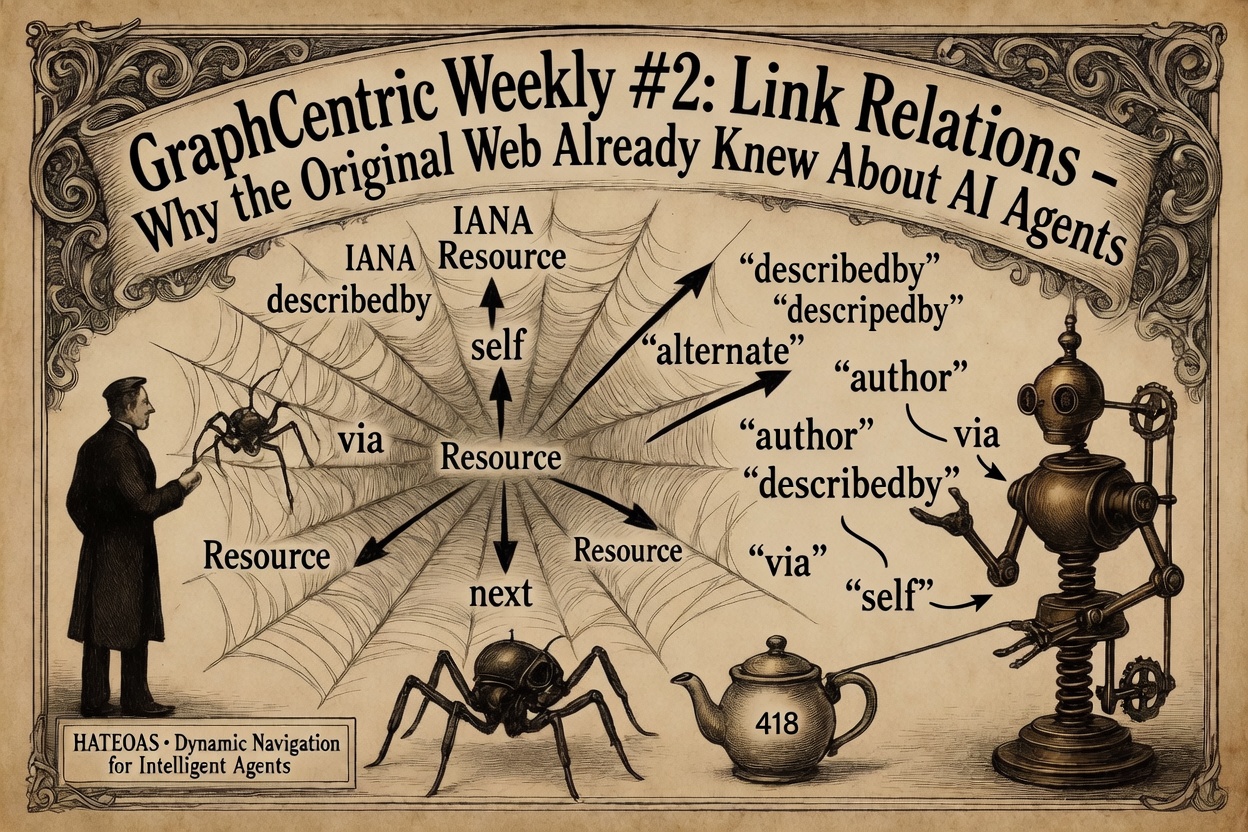
Welcome to the second edition of GraphCentric Weekly. This week we are exploring a key mechanism from the original World Wide Web that has new relevance in the age of AI: link relations.
Agents, Agents Everywhere
The word agent is having its moment. Yet the term agent was already central to the designers of the web as far back as 1990. The original vision always included non-human clients, most notably spiders and crawlers. Without those agents we would never have had search engines.
The designers of the web long anticipated what we now call the rise of the robots. They built the web to serve clients capable of making decisions, not just rendering pages for humans.
Humans and Machines Navigate Differently
Humans respond to visual design cues. AI agents can now do something similar, but it is expensive. They must consume large amounts of HTML, interpret visual semantics, and guess which links to follow. Machine-readable formats are far more efficient.
Link relations provide explicit, labeled cues. A link relation is a standardized keyword that describes the purpose of a link. Humans use visual design to choose their path. Machines follow these labeled relations instead.
Static APIs versus Dynamic Web Navigation
The dominant approach today is static: fixed API endpoints with known URIs, query parameters, and contracts. If the API changes, the client breaks. The alternative is dynamic: the machine interacts with the same resources a human would, following labeled links just as we do.
This dynamic philosophy is at the heart of REST. HATEOAS means the server tells the client what it can do next through links and their relations, rather than the client relying on hardcoded knowledge.
Final Thoughts
The web was designed for agents from the beginning. Link relations, HATEOAS, and dynamic clients close the loop. We have an opportunity to move beyond static interfaces and finish what the early web pioneers started.